

4 Views of a Vanished Café Jaaps Café Pretoria (3/4)
One Bridge too Many

Some cafés are good places to think about hard questions. Like how to encapsulate life under what might be called ‘high’ apartheid in South Africa. That seemingly endless half-century of absurdity, cruelty and triumphant stupidity. But as memories fade and dwindle, some revisionists suggest that apartheid, perhaps, wasn’t all that bad. This may be due to the almost universal disenchantment felt towards those who took power, after the apostles of apartheid slunk away with their hands, as someone remarked, covered in blood and gravy. But the revisionists are wrong. Anyone who remembers the epoch as anything other than a bizarre madhouse, where race morphed into religion, simply did not get out enough.
It is harder to say precisely what made the era of ‘high apartheid’ so weird. How effortlessly it turned the very peculiar into the entirely normal. And back again. No matter how well you thought you understood things, you were constantly confused. I was given a good lesson in confusion when I was about fifteen and I’ve never forgotten it. Nor the sheer disbelief on the faces of my friends in Jaaps café, when I told them what happened.
I’d been invited to tea at the home of a schoolmate, a day boy at my school. No boarder from St Anthony’s Hostel would turn down a tea invitation. Day boys had mothers who baked. I can still remember my friend’s name, Brendan Doyle. His mother’s scones at the Cake and Candy sales in the church hall were legendary. The Doyle home was a bike ride away, on the other side of the railway track that snaked through the veld, north of Jaaps café . My plan was two-fold. First, tea and all the scones I could eat. Next, on my ride back to the Hostel, I’d call in at Jaaps cafe, where I was sure to find friends.
I was a vague, absent-minded boy, regularly reminded by reproachful teachers that had my head not been screwed on good and hard, I’d have lost it in places where not even the good lord would find it. When I arrived at the railway station where I would cross the tracks, I knew that riding over the steel pedestrian bridge was forbidden. Dutifully, I carried my bike up the steel stairs and pushed it over the bridge. My mind was on tea and scones and I did not bother to read the notice or, if I was aware of it, I paid it no attention. Such signs were so familiar you looked right past them.
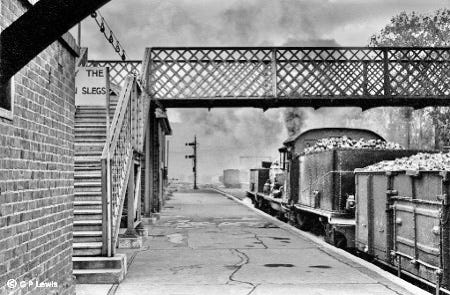
Typical pedestrian bridge at a Pretoria railway station, circa 1959. Warning sign overhead ( photo C P Lewis)
After tea, happily replete, I made my way back across the bridge. I had just manhandled my bike down the stairs when a huge man, with a moustache and a cap, bawled at me in Afrikaans: ‘What colour are you, my boy?’
It sounded such a silly question that, for a moment, I did not know what to say.
‘White,’ I said,’
He pointed to the sign on the stairs. It read: ‘Slegs Nie-Blankes ( ‘Non-Whites Only ’)
I knew instantly what I had done. All bridges in our bi-focal country, along with busses, trains, toilets, entrances, exits, beaches and graveyards, came in two shades, white and black. Sometimes, they might come in three or four, if also aimed at Asians or people of mixed race.
The station master said: ‘You’re black now. If you want to be a white boy again, take your bike back over the wrong bridge and cross by the right bridge.’
Embarrassed, disbelieving and astounded, I did as I was told. The Station Master watched me every step of the way as I underwent the journey that restored me to my suitable racial category.
When I called into Jaaps café and told my friends what had happened, they reacted much as I had done, with astonishment and disbelief. The general feeling was that I must be joking. No sensible person would believe me. But at the core of our surprise was a question – ‘why were we surprised?’ What I’d been through might sound crazy. But what would you expect if the world was run by those who spent their mono-maniacal lives imprisoning people in mythical categories that matched their ridiculous racist obsessions? Was this not South Africa, was this not what we did, and were these not the rules we lived and died by? If you ignored, forgot, or broke these rules, you risked exposure, public humiliation or penalties far worse. It might be that no one in their right mind believed any of this stuff but that did not mean it was not real. It was what we did, day after day, all the time.
Years later, I put this memory into a novel I called A Separate Development. The title is another of those euphemisms, like ‘Parallel Freedoms ‘, invoked by the old regime to give the rank stench of apartheid a sweeter smell. Our ever-busy busy South African censors saw the joke and replied in kind. They banned the book immediately. What could have been more normal?
In the 1980s, I travelled a good deal in East and West Germany and got to know something of the people and the politics on both sides of the Wall that divided the country. At the time, it was thought that if ever the Wall came down, Germans East and West would once again unite. This turned out not to be the case when the Wall came down. Many people, East and West, still have the Wall in their heads decades later. Something of the sort happened in South Africa. Apartheid has ended but it seems there is always one bridge too many to cross.
Christopher Hope