

Sunset Bar Vientiane Laos
Above all, don’t kick it

I traveled some years ago in Laos and whenever I was back in Vientiane, I headed for the Sunset Bar. It is in the Mekong River that meanders like a great wet road past the capital. The Sunset Bar was then a simple wooden platform, under a bamboo roof, beside the river. Some of its beams looked as if they had been taken from the old French villas of Vientiane and the bamboo roof was strung with fairy lights. On many evenings you got what the sign said on the door of the Sunset Bar, when river and sky collaborated in a giant light show.
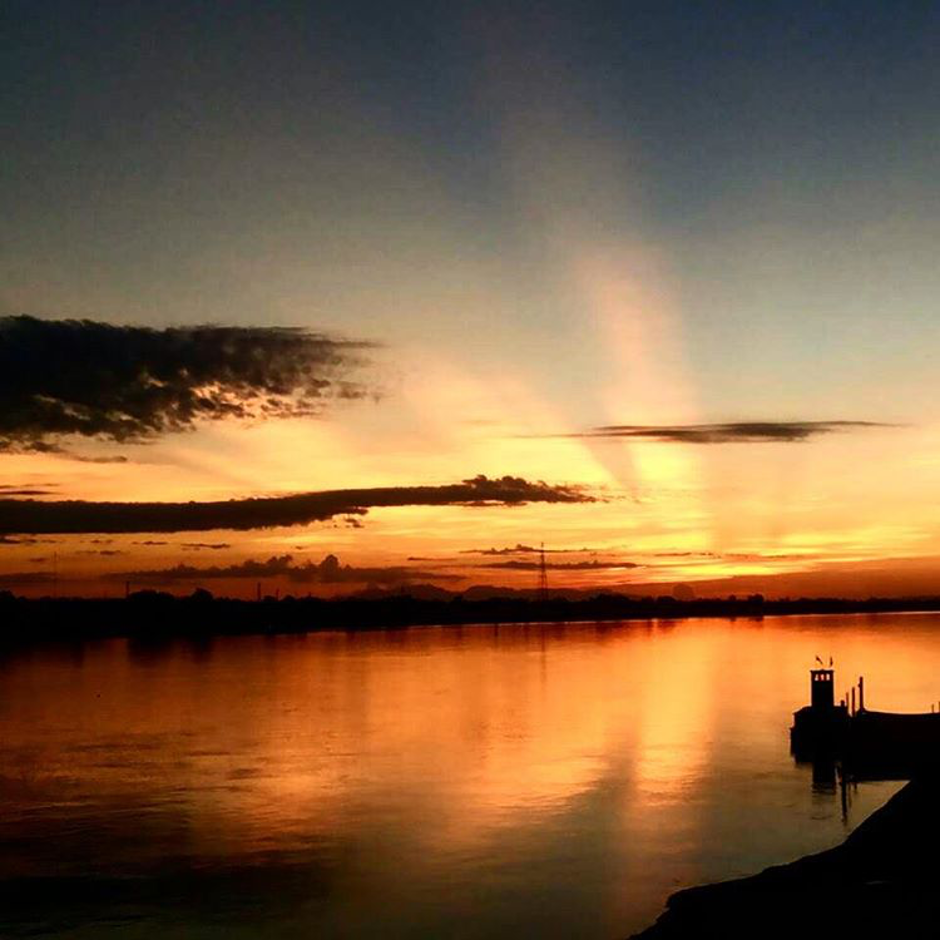
Sunset Bar Mekong River Vientiane Laos
When I was first in Vientiane, the Sunset Bar was one of the few congenial watering holes on the Mekong. The river banks are now planted with many more cafes and bars but the Mekong still rolls by, hugely indifferent to neon and noise. As dusk fell I sat in the Sunset bar, reading the Vientiane Times, watching the Mekong sweeping past like a great wet road. I could see the lights of Thailand begin to shine on the other side of the river.
Laos is a placid place, perhaps because Laotian Buddhism is a peaceful creed. But upon its tranquil surface floats a rather surreal Marxism and it pays to read the fine print. Not for nothing are the letters PDR (People’s Democratic Republic) tacked onto its name like a health warning on a packet of fags. Yet in their laid-back way, the Lao somehow pay lip service to the pomposities of political dogma but do it by barely moving their lips.
If Laotians have never been especially warlike, that has not stopped other powers from dropping in. Laos is locked in by its neighbours. On one side, Thailand bustles, and on the other side, Vietnam surges. Over the decades, Chinese, Russians and Americans have all found Laos a useful pawn, whenever they felt a war coming on. But the news I read in the Vientiane Times of recent dental hostilities in Thailand was unexpected.
The Vientiane Times was a good enough paper, as government propaganda sheets went. It reported that a band of devout believers, based in Thailand, possessed one of the Buddha’s teeth, saved after his cremation, almost three millennia earlier. The Chinese regime angrily dismissed the denture as a fak, manufactured by renegade Tibetan exiles. ‘We possess the only true tooth,’ said the Chinese. ‘Oh no you don’t,’ replied the true believers. And so there began what became known as The War of Buddha’s Tooth.
I was back in peaceful Vientiane after a trip to Luang Prabang, once the royal capital of Laos. The palace of the old Lao Kings is a golden barn built by the Frenc, a place of red plush and silent sadness. Here, the last monarch of Laos, Lord of the Land of a Thousand Elephants held court. The king survived into the Communist era and died in 1975. It is thought he and the queen starved to death in a remote mountain cave, prisoners of the Pathet Lao . His collection of vintage cars rusts away in the palace grounds, and on the royal tennis court, there is nothing but weeds and washing lines .
I had been traveling across the Plain of Jars, near the Vietnamese border . This vast flat green space is set about with the huge stone gourds that give the plain its name, buried up to their ears with their necks above ground. These giant jars may be thousands of years old but no one seems quite sure what they were once used for. I like the legend that they were used to brew rice wine, or ‘lao-lao’, for some tremendous booze-up long, long ago.
The Plain of Jars is lovely but lethal. During the Vietnam War, the Americans dropped more bombs on this part of Laos than had been dropped anywhere before. American pilots flying back to their bases in Thailand, after bombing raids on Hanoi and Haiphong, ditched their remaining bombs on the Plain of Jars. The countryside was strewn with unexploded ordinance, known as UXO. Some 78 million pieces of it. A man who tracked down UXO for an outfit called MAG, the Mines Advisory Group, gave me some advice when he heard I was headed to the Ho Chi Minh trail. ‘Up near the Vietnamese border, if you see anything metallic, don’t touch or move it. Above all, do not kick it!’
His advice was invaluable. In an Alak village near the border, the address system was playing Cherry Pink and Apple Blossom White. The school teacher showed me the school bell and suggested I ring it by hitting it with a hammer. The bell has iron fins and a sharp nose and I suppose they had been safely banging it for years. I turned down his offer
It was calming to get back to Vientiane and walk to the river. Tuk-tuks puttered past and their red plastic seats and painted awnings made them look a bit like lacquered snail shells. The monsoon rains were near and moving through the wet lukewarm air felt more like paddling. A plump Buddhist monk, holding over his head a large open umbrella rolled by, an orange beneath a parachute. Under the bamboo awning of the Sunset Bar, I drank cold Lao beer and watched the frisbee players on the river bank as sunset streaked the sky.
Christopher Hope
Christopher, thank you for this read. I travelled bits of the Mekong via Vietnam, Cambodia and Laos during 2013. You have surfaced great memories for me.